


Page 8 - OIT Progress Report: 2025 Edition
P. 8
Exploring Transformation with
Artificial Intelligence
Artificial intelligence (AI)
technologies have become
increasingly prevalent and
are now integrated into a
wide array of applications. As
adoption continues to grow, both administrative
and educational environments are faced with
important ethical considerations. OIT has
been actively evaluating AI use cases as well
as the associated ethical questions concerning
appropriate utilization and oversight.
Internally, OIT teams have assessed various
AI tools to support code development, data
analysis, documentation creation, automation,
and additional tasks. The management team
participated in an intensive prompt-a-thon
workshop to discuss potential applications of AI
at SMU. Considerable research was conducted
regarding available agents, platforms, cost
analysis, security, and practical use. We piloted a
platform called Liminal, which offers connections
to multiple AI solutions in a secure environment,
and will be offering this platform to a limited
number of users who manage highly sensitive data
in the 2025-2026 academic year.
In collaboration with campus stakeholders,
guidance on the use of AI was developed. This
information was published on our website
(smu.edu/ai) and offers a centralized resource
aligned with SMU policies and procedures for
5 OIT PROGRESS REPORT 2024
faculty, staff, and students. Although establishing
a comprehensive policy on AI use can be
challenging, it remains essential for the university
community to understand the security and ethical
implications of these technologies.
Academic Initiatives with AI
For Fall 2024, several initiatives focused
specifically on the academic environment.
Working closely with the Provost’s office, syllabus
statements were created and approved regarding
the use of AI in a course. Faculty were encouraged
to select one of the statements to clarify whether AI
was permitted for use within each course.
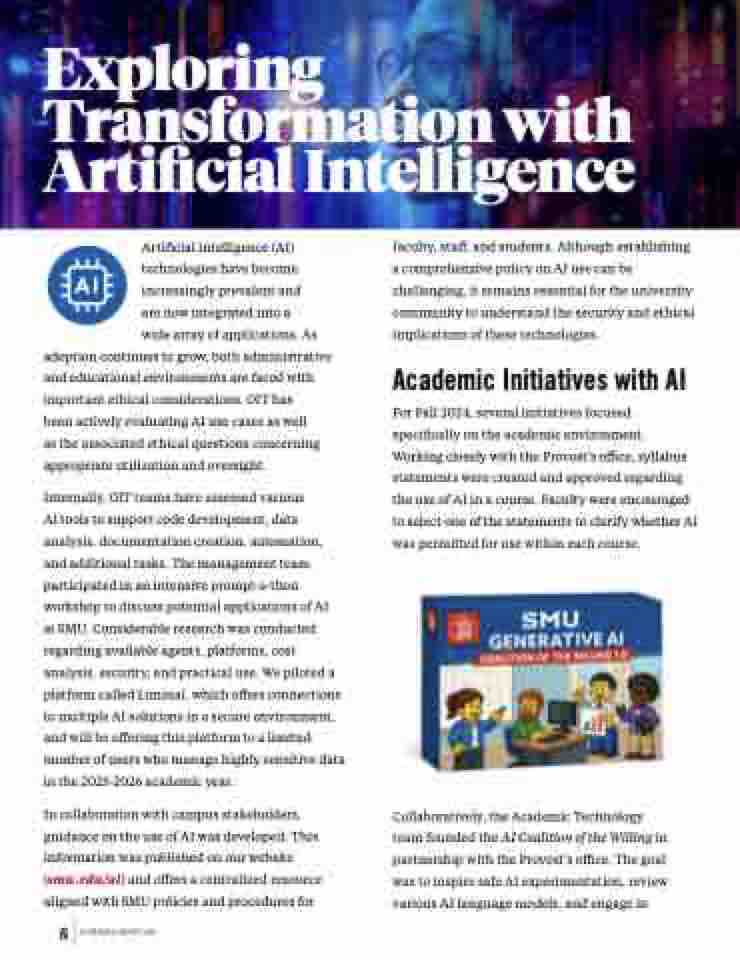
Collaboratively, the Academic Technology
team founded the AI Coalition of the Willing in
partnership with the Provost’s office. The goal
was to inspire safe AI experimentation, review
various AI language models, and engage in


