


Page 15 - OIT Progress Report: 2025 Edition
P. 15
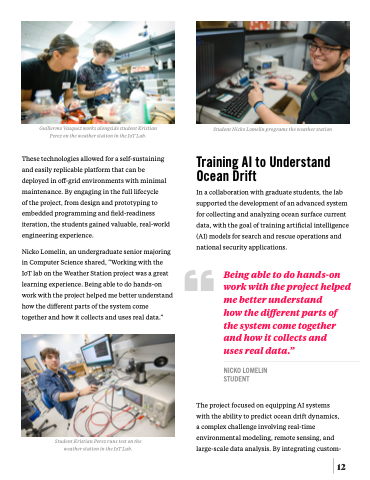
Guillermo Vasquez works alongside student Kristian
Perez on the weather station in the IoT Lab.
These technologies allowed for a self-sustaining
and easily replicable platform that can be
deployed in off-grid environments with minimal
maintenance. By engaging in the full lifecycle
of the project, from design and prototyping to
embedded programming and field-readiness
iteration, the students gained valuable, real-world
engineering experience.
Nicko Lomelin, an undergraduate senior majoring
in Computer Science shared, “Working with the
IoT lab on the Weather Station project was a great
learning experience. Being able to do hands-on
work with the project helped me better understand
how the different parts of the system come
together and how it collects and uses real data.”
Student Kristian Perez runs test on the
weather station in the IoT Lab.
Student Nicko Lomelin programs the weather station
Training AI to Understand
Ocean Drift
In a collaboration with graduate students, the lab
supported the development of an advanced system
for collecting and analyzing ocean surface current
data, with the goal of training artificial intelligence
(AI) models for search and rescue operations and
national security applications.
“ Being able to do hands-on
work with the project helped
me better understand
how the different parts of
the system come together
and how it collects and
uses real data.”
NICKO LOMELIN
STUDENT
The project focused on equipping AI systems
with the ability to predict ocean drift dynamics,
a complex challenge involving real-time
environmental modeling, remote sensing, and
large-scale data analysis. By integrating custom-
12


